
Jesse James
- Born
- September 5, 1847
- Died
- April 3, 1882
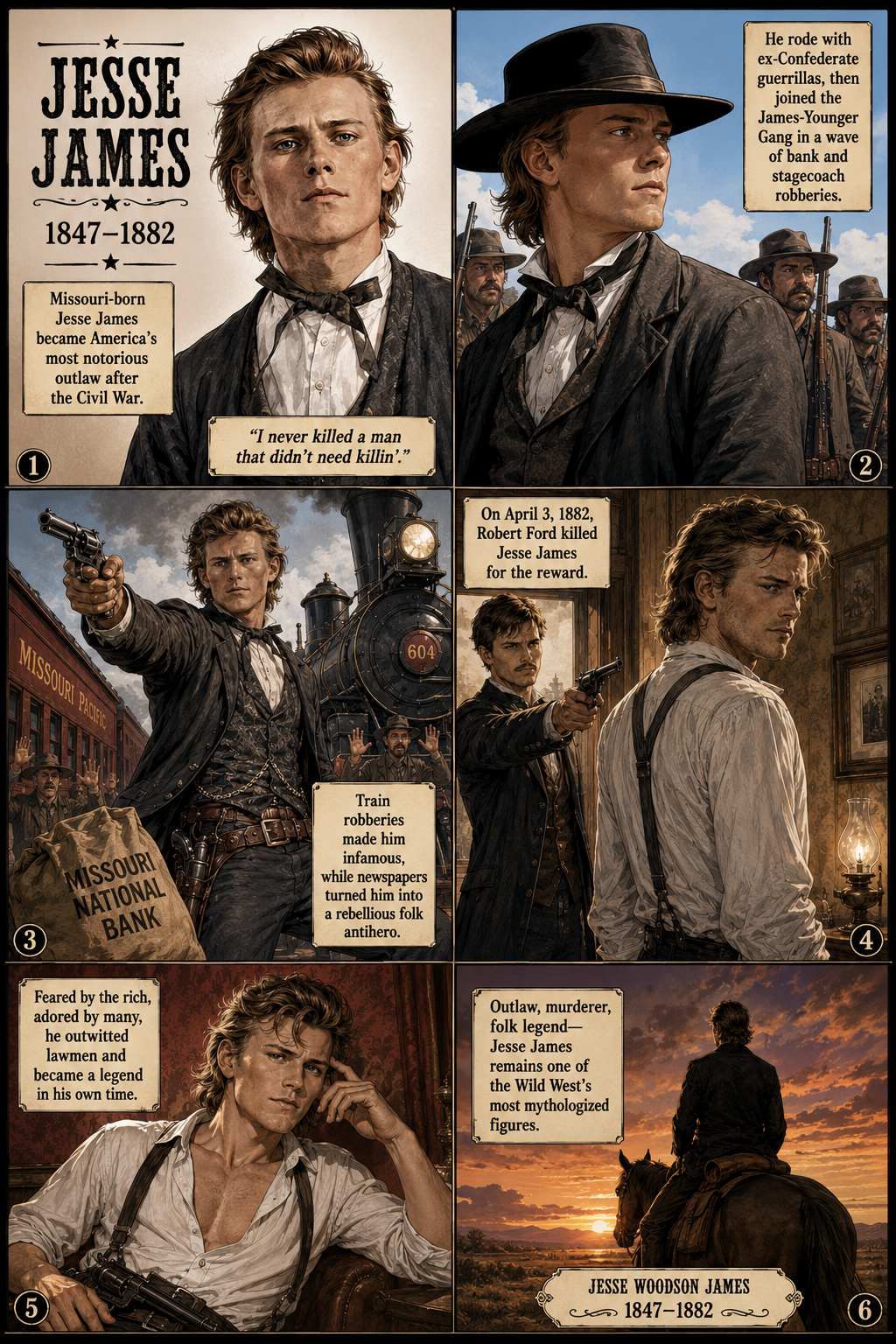
Read transcript
Jesse James, 1847–1882.
-
Panel1 SceneA young Jesse James poses in formal clothes beside a title card.
TextMissouri-born Jesse James became America’s most notorious outlaw after the Civil War.
I never killed a man that didn’t need killin’.
-
Panel2 SceneJames rides with armed former Confederate guerrillas beneath a wide-brimmed black hat.
TextHe rode with ex-Confederate guerrillas, then joined the James-Younger Gang in a wave of bank and stagecoach robberies.
-
Panel3 SceneJames points a revolver beside a train and a Missouri National Bank money sack.
TextTrain robberies made him infamous, while newspapers turned him into a rebellious folk antihero.
-
Panel4 SceneRobert Ford aims a pistol at James's back inside a lamplit room.
TextOn April 3, 1882, Robert Ford killed Jesse James for the reward.
-
Panel5 SceneJames reclines with a revolver in a red-walled room.
TextFeared by the rich, adored by many, he outwitted lawmen and became a legend in his own time.
-
Panel6 SceneA lone rider watches the sunset over the American West.
TextOutlaw, murderer, folk legend—Jesse James remains one of the Wild West’s most mythologized figures.
Jesse Woodson James, 1847–1882.
Fact-check note: Jesse James was born September 5, 1847, and killed by Robert Ford on April 3, 1882. He joined violent pro-Confederate guerrillas as a teenager and later robbed banks, stagecoaches, and trains; “rebellious folk antihero” describes a mythology promoted by sympathetic newspapers, not evidence that he shared stolen money with ordinary people. Ford killed James while cooperating with authorities and seeking reward money, although accounts differ over whether the available reward was $5,000 or $10,000 and how much Ford received. The line “I never killed a man that didn’t need killing” is widely attributed to James but lacks a reliable primary citation and should be treated as legend. Missouri State Archives · PBS American Experience · Library of Congress guide