
Catherine the Great
- Born
- May 2, 1729
- Died
- November 17, 1796
Read transcript
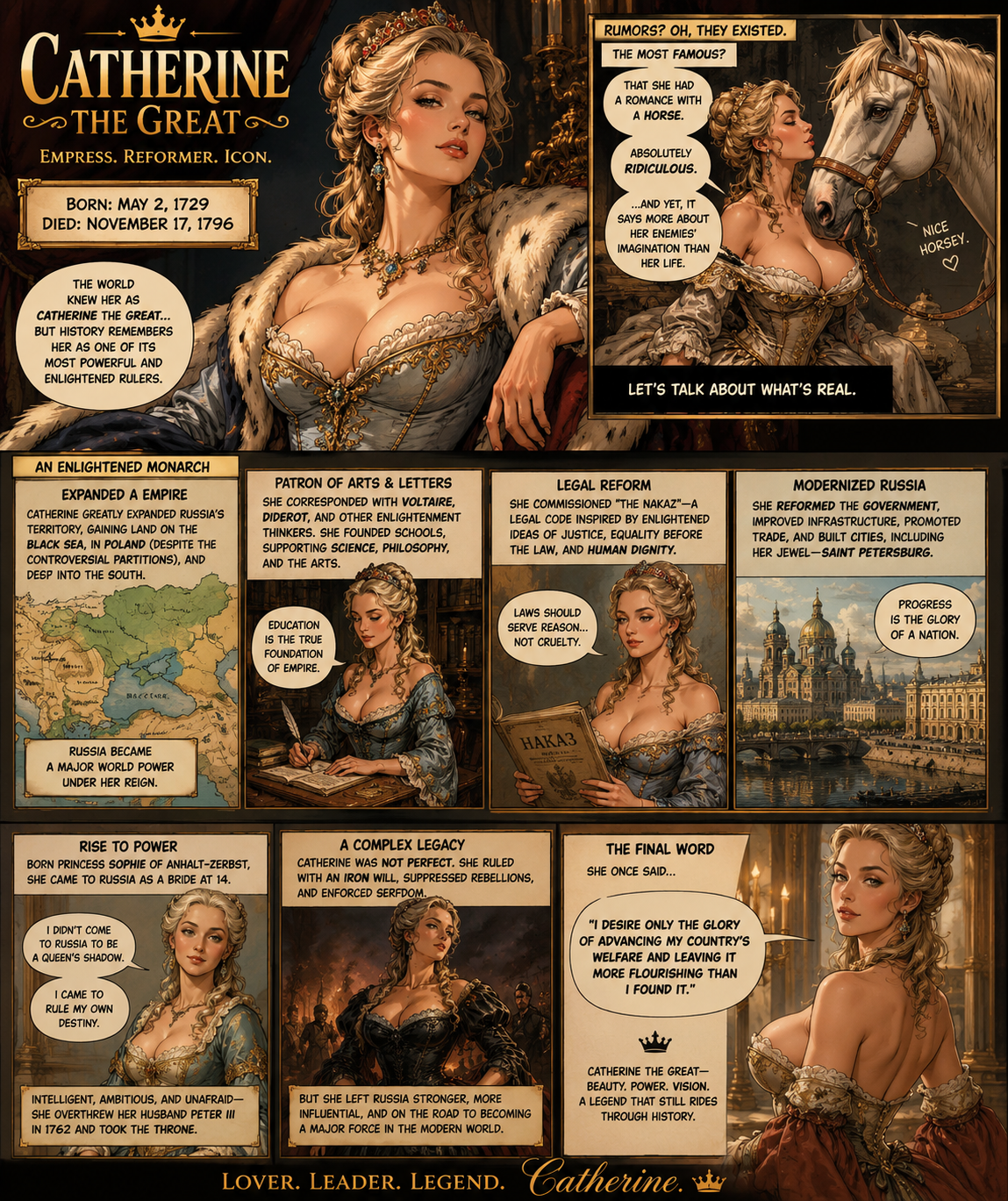
A lavish gold-and-black historical comic combines portraits of Catherine the Great with captions about her reign, reforms, expansion, and contested legacy.
-
PanelTitle and opening portrait SceneCatherine poses in an imperial gown, crown, jewels, and ermine.
TextCatherine the Great. Empress. Reformer. Icon.
Born: May 2, 1729. Died: November 17, 1796.
The world knew her as Catherine the Great... but history remembers her as one of its most powerful and enlightened rulers.
-
PanelPanel 1 — The horse rumor SceneCatherine affectionately greets a white horse while the comic rejects the notorious sexual rumor about her death.
TextRumors? Oh, they existed. The most famous?
That she had a romance with a horse.
Absolutely ridiculous.
...And yet, it says more about her enemies' imagination than her life.
Nice horsey! ♥
Let's talk about what's real.
-
PanelPanel 2 — Territorial expansion SceneA map shows the Russian Empire and surrounding regions.
TextAn enlightened monarch — Expanded a empire.
Catherine greatly expanded Russia's territory, gaining land on the Black Sea, in Poland (despite controversial partitions), and deep into the south.
Russia became a major world power under her reign.
-
PanelPanel 3 — Patron of arts and letters SceneCatherine writes at a desk in a grand library.
TextShe corresponded with Voltaire, Diderot, and other Enlightenment thinkers. She founded schools, supported science, philosophy, and the arts.
Education is the true foundation of empire.
-
PanelPanel 4 — Legal reform SceneCatherine holds a book labeled Nakaz.
TextShe commissioned the 'Nakaz'—a legal code inspired by Enlightened ideas of justice, equality before the law, and human dignity.
Laws should serve reason... not cruelty.
-
PanelPanel 5 — Modernized Russia SceneA cityscape of domes, bridges, and waterfront buildings represents imperial Russia.
TextShe reformed the government, improved infrastructure, promoted trade, and built cities, including her jewel—Saint Petersburg.
Progress is the glory of a nation.
-
PanelPanel 6 — Rise to power SceneA younger Catherine appears in court dress.
TextBorn Princess Sophie of Anhalt-Zerbst, she came to Russia as a bride at 14.
I didn't come to Russia to be a queen's shadow.
I came to rule my own destiny.
Intelligent, ambitious, and unafraid—she overthrew her husband Peter III in 1762 and took the throne.
-
PanelPanel 7 — A complex legacy SceneCatherine stands before a dark scene of unrest and soldiers.
TextCatherine was not perfect. She ruled with an iron will, suppressed rebellions, and enforced serfdom.
But she left Russia stronger, more influential, and on the road to becoming a major force in the modern world.
-
PanelPanel 8 — The final word SceneCatherine looks over her shoulder in a palace interior.
TextShe once said...
I desire only the glory of advancing my country's welfare and leaving it more flourishing than I found it.
Catherine the Great—beauty. Power. Vision. A legend that still rides through history.
-
PanelClosing banner TextLover. Leader. Legend. Catherine. ♛
Fact-check note: The horse story is a misogynistic myth; Catherine died after a stroke. She wrote, rather than merely commissioned, the Nakaz or Instruction, but it never became a new legal code. Its Enlightenment language also sat uneasily beside her expansion of serfdom and suppression of revolt, so “equality before the law” should not be read as an achieved reform. Dates use the modern Gregorian calendar; contemporary Russian dates were 11 days earlier. TIME historical review · Britannica biography