
Ada Lovelace
- Born
- December 10, 1815
- Died
- November 27, 1852
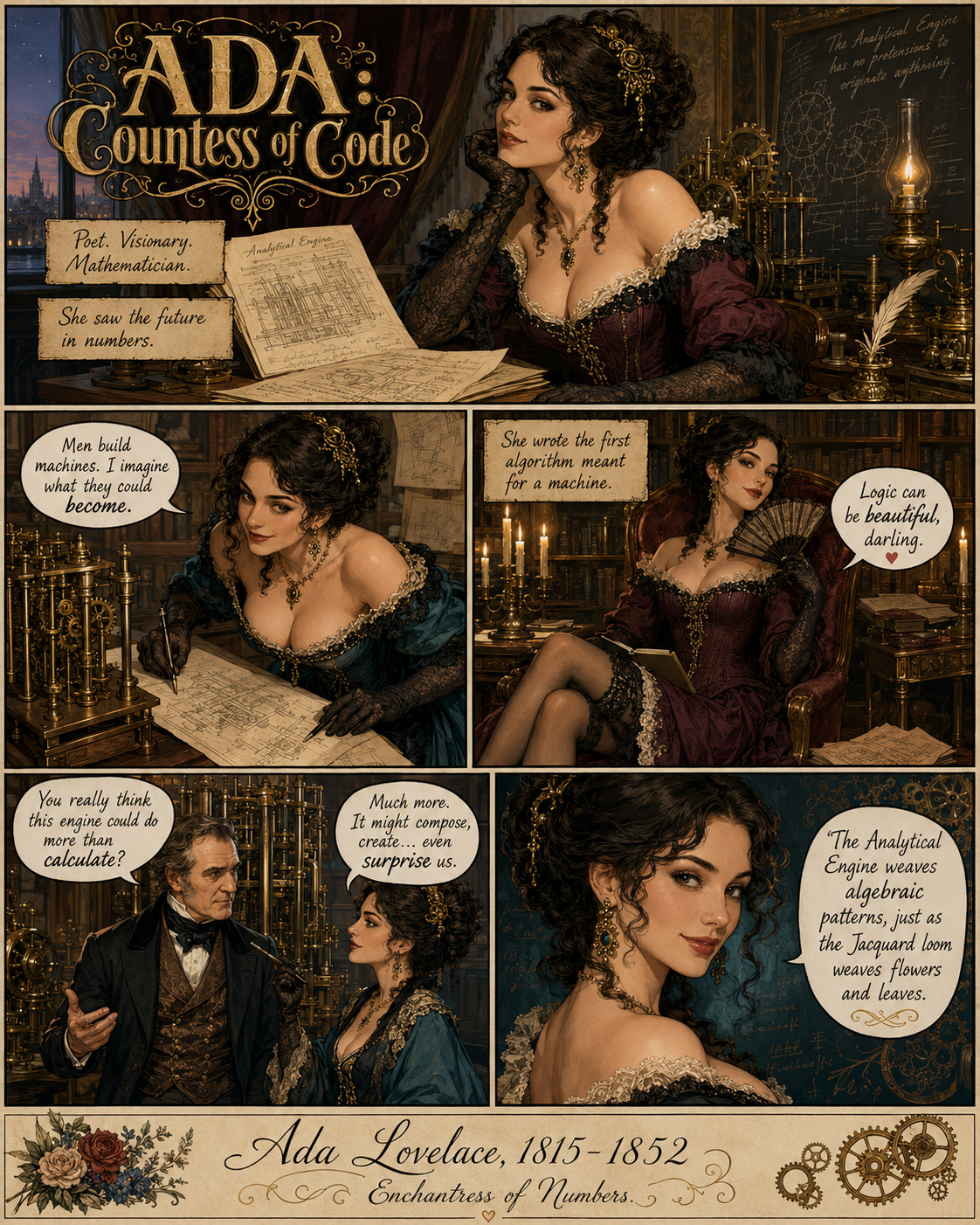
Read transcript
An ornate, sepia-and-gold Victorian comic presents Ada Lovelace as a visionary mathematician imagining creative uses for Charles Babbage's Analytical Engine.
-
PanelTitle and opening portrait SceneAda sits at a desk covered with mechanical plans, beside brass machinery and a glowing oil lamp.
TextADA. Countess of Code.
Poet. Visionary. Mathematician.
She saw the future in numbers.
-
PanelPanel 1 — Imagining machines SceneAda writes beside a brass calculating mechanism in a candlelit study.
TextMen build machines. I imagine what they could become.
-
PanelPanel 2 — The first algorithm SceneAda reclines with a fan amid books, candles, and machinery.
TextShe wrote the first algorithm meant for a machine.
Logic can be beautiful, darling. ♥
-
PanelPanel 3 — Ada and Charles Babbage SceneCharles Babbage and Ada stand before a large brass mechanism.
TextYou really think this engine could do more than calculate?
Much more. It might compose, create... even surprise us.
-
PanelPanel 4 — Algebraic patterns SceneAda looks back toward the reader against a chalkboard of mathematical diagrams.
TextThe Analytical Engine weaves algebraic patterns, just as the Jacquard loom weaves flowers and leaves.
-
PanelClosing banner SceneA parchment banner decorated with flowers and brass gears closes the page.
TextAda Lovelace, 1815–1852.
Enchantress of Numbers.
Fact-check note: Lovelace’s 1843 notes include an algorithm for Bernoulli numbers intended for Babbage’s unbuilt Analytical Engine and famously imagine machines manipulating symbols and composing music. Calling it the “first algorithm” is too broad; “the first published computer program” is the more defensible formulation, though historians debate priority and attribution. Dialogue in the panels is dramatized. Science Museum Group · NIST