
Queen Christina
- Born
- December 8, 1626
- Died
- April 19, 1689
Read transcript
Queen Christina of Sweden (1626–1689).
-
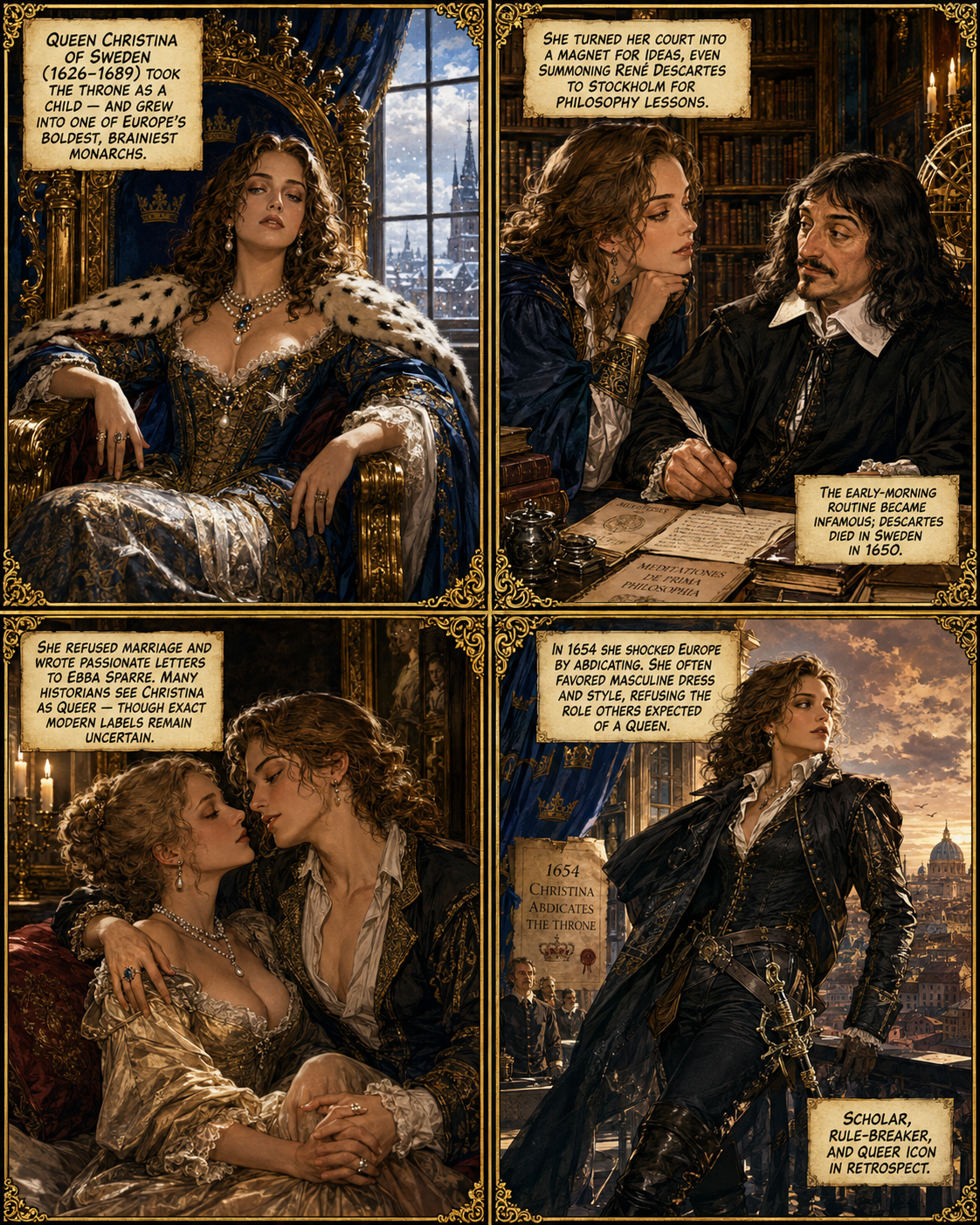
Panel1 SceneChristina sits on a gilded throne in blue royal dress and an ermine-trimmed cloak above snowy Stockholm.
TextQueen Christina of Sweden (1626–1689) took the throne as a child—and grew into one of Europe’s boldest, brainiest monarchs.
-
Panel2 SceneIn a candlelit royal library, Christina listens closely as René Descartes writes beside her.
TextShe turned her court into a magnet for ideas, even summoning René Descartes to Stockholm for philosophy lessons.
The early-morning routine became infamous; Descartes died in Sweden in 1650.
-
Panel3 SceneChristina shares an intimate embrace with courtier Ebba Sparre.
TextShe refused marriage and wrote passionate letters to Ebba Sparre. Many historians see Christina as queer—though exact modern labels remain uncertain.
-
Panel4 SceneAfter abdicating, Christina stands above a city in masculine seventeenth-century dress with a sword at her side.
TextIn 1654 she shocked Europe by abdicating. She often favored masculine dress and style, refusing the role others expected of a queen.
Scholar, rule-breaker, and queer icon in retrospect.
Fact-check note: Christina was born December 8, 1626, became queen as a child, abdicated June 6, 1654, later converted to Catholicism, and died April 19, 1689. She invited René Descartes to Stockholm; their philosophy sessions began at 5 a.m., and he died there in February 1650, although the familiar story that the schedule and Swedish cold directly killed him is an interpretation rather than a settled fact. Christina’s passionate surviving letters to Ebba Sparre support queer readings, but the physical nature of their relationship and the modern label Christina would have chosen remain uncertain. Her clothing, refusal to marry, and rejection of conventional female expectations are well documented. Swedish Women’s Biographical Dictionary · Stanford Encyclopedia of Philosophy · Lund University research on the letters